 Digital wine list
•
10 September 2026
Digital wine list
•
10 September 2026
A debate is gaining ground in the trade: wine sales are eroding while younger drinkers turn to beer, whose language and marketing feel more accessible. At the centre of the criticism sits the complexity of wine — varieties, appellations, vintages, jargon — which can lose a guest who is in a hurry or new to it. For restaurants, wine bars and hotels the task is clear: make wine immediately understandable, desirable and easy to buy. Here is a concrete method for simplifying the offer, rethinking the list, and using digital tools to win back ground on the floor.
Wine carries terroir, history, and the work of people. But at the moment of choosing, too much information stops the decision. Faced with a wall of labels or a dense list, a guest hesitates, defers, or picks by default. Beer, with its simple categories, clear promises and legible formats, holds attention more easily — particularly among younger adults.
The lesson is not to impoverish wine but to adapt how we talk about it. Simplifying does not mean giving up authenticity. It means putting the guest's understanding ahead of the trade's internal conventions.
On the floor, too many references kill the decision. A short list built as a path through the styles beats page after page of cuvées. Concentrate on clear choices: a few sparkling wines, six to eight whites organised by style, eight to twelve reds covering the main uses, two or three rosés, and one or two low-intervention options where they fit. A short list gets read, gets remembered, and converts.
Grouping by appellation speaks to people who already know. Grouping by style, benefit and moment speaks to everyone. Offer legible segments: crisp and refreshing, fruity and generous, spiced and structured, sparkling, for the aperitif, for red meat, for fish. Guests navigate by mood and taste, not by technical specification.
Format is part of the comfort of buying, and the growth of by-the-glass service shows how much guests like to try without committing. Display clearly:
Appellations and vintages remain essential to authenticity and positioning. But in the copy, start with what the wine will do at the table. A few lines are enough:
Then, and only then, give the appellation, the estate and the vintage. Guide by use first, and establish credibility by origin second.
Clear headings, simple words, taste markers for dry, fruity, oaked or tannic, and a strong visual hierarchy — all of it borrowed from categories that read faster than wine does. Without caricature, take a more direct tone, oriented around the moment of drinking.
Three lines beat three paragraphs. Drop the jargon when the job is to help someone choose:
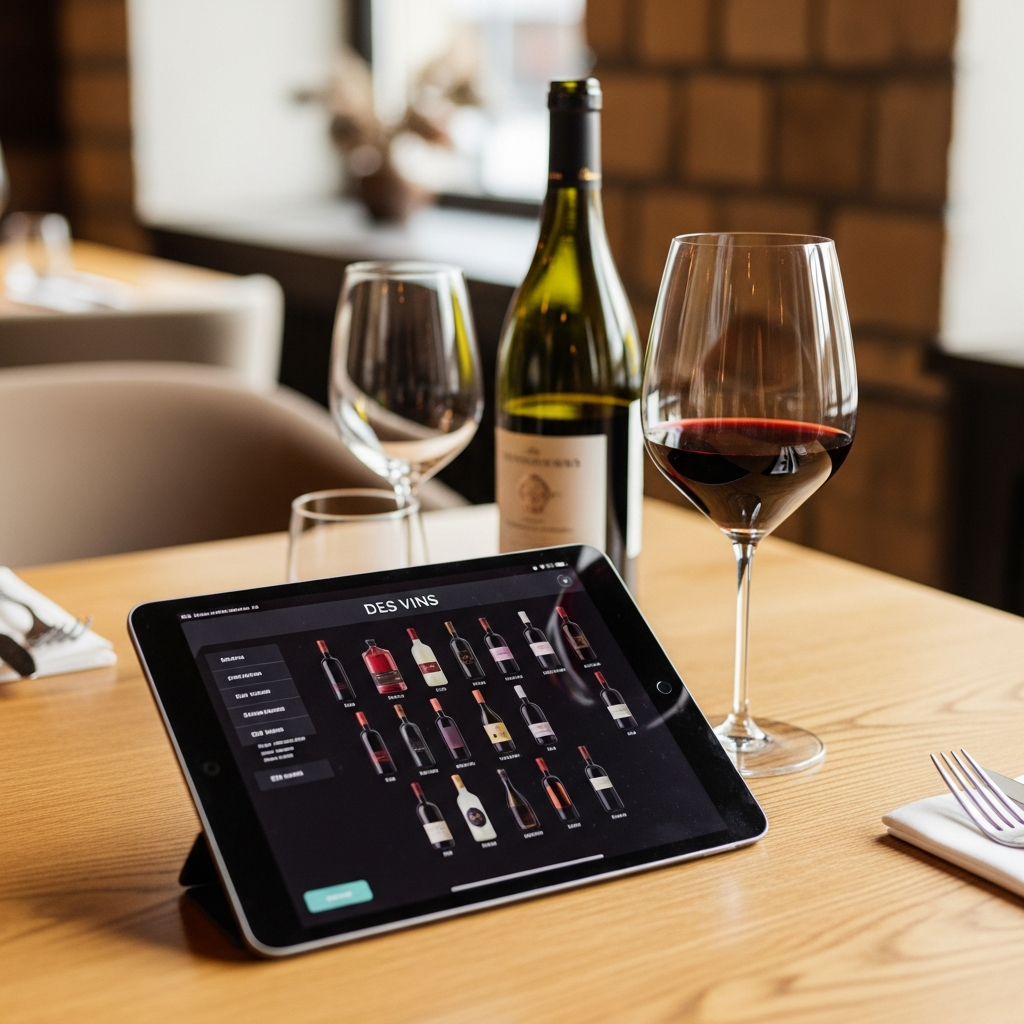
Digital tools let you carry out this simplification without losing the richness underneath. A list reachable by QR code or on a tablet is clearer, more alive and more current than a frozen paper support. The guest explores at their own pace, the team saves time, and the floor moves faster.
The advantages on the floor:
Digital does not erase human expertise, it stages it. Your team stays at the centre of the recommendation and the welcome, while the list and the virtual sommelier give the guest the markers that let them decide.
Simplifying does not mean flattening. Every room has a signature: the terroirs it loves, the growers it knows, the region at its heart. The point is to let that identity show through a clear path. Keep your finds, and make them easy to choose. A guest should understand in ten seconds what a wine will taste like, what it goes with and what it costs, and be able to test it by the glass before going further.
No. It structures the information, reassures and guides. A person is irreplaceable for reading the context — the occasion, the table, the budget — and for creating the moment. The two are complementary.
Offer both. A clear card with a QR code on the table, and a tablet presented by the team or a short printed version alongside. The guest picks the channel and the content stays the same.
Both have their place. Brands give recognition and recall, appellations anchor origin and authenticity. Start with the promise of use and taste, then give the origin to back it up.
Yes. Start with your twenty key references, structured by style and use, and put those online. Adjust as feedback comes in during service. Clarity of the path matters far more than being exhaustive on day one.
Everything you need to know to successfully digitalize a restaurant, wine bar, or hotel: benefits, 90-day roadmap, tools, mistakes to avoid, and a focus on digital wine lists.<\/p>

In the restaurant sector, innovation and customer experience have become key factors for differentiation. Among the emerging trends, the digitization of the wine list stands out as an essential tool for restaurants and wine bars. This digital transformation not only modernizes the presentation of wines, […]
Are you looking to create a free online restaurant menu quickly and without a hitch? Here’s a clear guide with concrete options, step-by-step instructions, templates, and a focus on QR codes — with a professional alternative if you want to go further.<\/p>
For 1 month with no commitment