 Wine & restaurant
•
20 October 2026
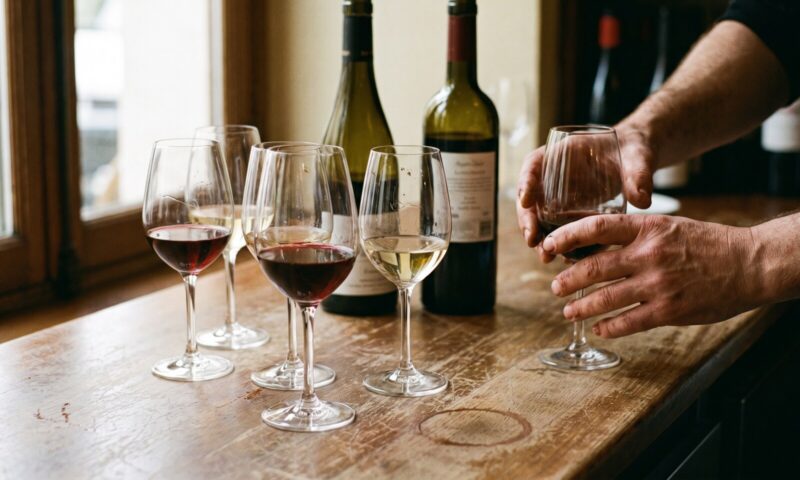
How many wines by the glass to offer in a restaurant is a question with no single answer, which is why it is usually asked the wrong way. People look for a number of wines by the glass when they should first answer two other questions. How many glasses do you sell per service, and how many days does an opened bottle last at your place.
The number then comes out on its own. It isn't a matter of taste, it is an arithmetic consequence.
The operating rule fits in one sentence. A by-the-glass wine must be emptied before it spoils.
An opened wine lasts two to three days without a preservation system, a little longer for a white kept cold, a little less for a light red left at room temperature. If your venue serves forty glasses per service and you offer twenty wines, each one sells two glasses per service. The bottle takes nearly three days to empty, and you serve tired wine from the third day on.
Run the calculation the other way, it is more telling. Take your glasses sold per day, divide by the number of glasses in a bottle, five to six depending on your pour size, and you get the number of bottles you actually empty each day. Your by-the-glass selection should not exceed three times that number.
A bistro that empties three bottles a day can therefore hold eight to nine wines. A wine bar that empties fifteen can hold forty without difficulty. The second isn't more ambitious than the first, it simply has the throughput that allows it.
This is the most widespread mistake, and it comes from comparing venues that are not in the same business.
A restaurant sells wine as an accompaniment. The guest orders food, then chooses a glass. The wine follows the meal, so the selection must cover the dishes on the menu and nothing more: a crisp white, a full-bodied white, a light red, a structured red, a rosé in season, a sparkling. Six lines are enough to never leave a table without a solution.
A wine bar sells wine as the main product. Guests come for that, they compare, they come back to try something else. The selection is the offer itself, and a list of ten wines looks poor there where it would be generous in a bistro.
In between, the brasserie and the fine-dining restaurant each have their own logic: the first sells volume on few wines, the second sells few glasses but accepts rare wines because gas preservation is common there.
Determine your trade before choosing your number. A wine bar's range applied to a bistro produces a list nobody finishes.
Once the number is set, the question becomes that of the wines themselves.
Build by table need, not by region. The guest never thinks "I would like a Languedoc", they think "I'm having the fish" or "I want something light". Your by-the-glass selection must answer those sentences.
Here are the slots to cover, in the order in which they go missing when they do.
Anything you add beyond that has to earn its place. One more wine means one more bottle open every day, so one more risk of loss. It only makes sense if it sells on its own, or if it makes an argument the first six don't.
The question of price is handled separately, and we have detailed it in our method for pricing wine by the glass. It comes after this one, because you first choose what you serve and price it afterwards.
Rotating wine by the glass isn't a stock topic, it is a decision topic. A well-kept by-the-glass list splits into two parts, and they aren't managed the same way.
The core doesn't move. These are your four to six base slots, the same all year round, with the same wines or nearly so. Your team knows them by heart, sells them without hesitation, and the regular guest finds them again. This core is what makes your volume.
The moving part changes every two to four weeks. Two or three lines, no more. This is where you put the seasonal wine, the discovery, the producer you want to push. It gives your list a reason to be reread, and it lets you test before committing a wine to the core.
The rhythm matters more than the scale. A change every three weeks on two lines gets noticed; a complete overhaul twice a year doesn't get noticed at all, because nobody remembers a list long enough to see the difference.
Set the day. The same one every time, early in the week, when service is calm and the supplier order hasn't gone out yet. A rotation that depends on inspiration doesn't survive three busy weeks.
Everything above assumes that changing a line costs you little. On a paper list, it costs a reprint, so you wait, so the moving part stops moving and the list freezes.
This is the point the digital list truly shifts. A wine you remove disappears from the guest's list once the change is saved, and a wine you add appears with its serving size and its price without anyone touching a layout. The serving size, precisely, is a field of the price line: you choose the serving, from the 12 centiliter glass to the pitcher, and the guest reads what they pay.
On the outgoing side, a stock movement is marked as a sale or as a loss, which gives you, after the fact, the material to decide: a wine that regularly shows up as a loss has no place by the glass, whatever your affection for it.
The rest is floor discipline, and no tool replaces it. If you want to test the mechanics on your own wines before changing anything, you can create a wine list for free and see what your selection looks like once laid out.
For the overall structure of the list, the examples and the trade-offs that go beyond the by-the-glass program alone, everything is gathered in our guide to the restaurant wine list. Wine by the glass is its most profitable and most fragile part. That is where the margin is made, and that is where it is lost.

Showing allergens on a restaurant wine list: sulfites, the serving size and the exact appellation, and how to keep them up to date.
Are you thinking of deploying tablets in your restaurant? Discover how to choose the equipment, structure your menu (and your digital wine list), manage costs, and maximize ROI without degrading the in-room experience.<\/p>
Everything you need to know to successfully digitalize a restaurant, wine bar, or hotel: benefits, 90-day roadmap, tools, mistakes to avoid, and a focus on digital wine lists.<\/p>
For 1 month with no commitment